

PROGRAM
The Freeway Service Patrol, sponsored by GEICO, is a proven traffic congestion relief program
that saves motorists time and money. It provides free emergency
roadside service to motorists, keeps the freeways clear and prevents traffic from
backing up and causing longer commute times, especially during peak rush hours.
Less time on the road also means everyone saves on fuel costs and reduced emissions.
It has been successfully implemented in many urban areas across the country such as
Los Angeles, San Francisco, San Diego, Orange County, Las Vegas, Chicago, Florida,
Maryland, New York, and many others.
Studies show bottlenecks from stopped vehicles create a chain reaction and can
cause "secondary crashes" which create more traffic congestion and delays.
Clearing the freeways keeps Hawai'i moving and everyone safe.
The Freeway Service Patrol program is operated by the State of Hawai`i
Department of Transportation in collaboration with the City and County of Honolulu's
Police, Fire, Emergency Medical Services and the Department of Transportation
Services.
The Freeway Service Patrol provides free emergency roadside assistance to
motorists who are stranded on the H-1, H-2 and the H-201 (Moanalua) freeways and
assists HPD at crash scenes by providing traffic control assistance. These services
help keep freeways clear, preventing traffic backups and reducing the risk of
secondary crashes caused by traffic congestion. Less time on the road also means
savings on fuel costs and reduced emissions.
On June 17, 2009, the Freeway Service Patrol Program was launched in Hawai’i.
The Freeway Service Patrol services are available Monday through Friday from 5:00 a.m. to 7:00 p.m., except for holidays observed by the State of Hawai`i.
The Freeway Service Patrol covers approximately 33 miles of freeway in both
directions, including a 26 mile stretch along the H-1 freeway from Makakilo Drive to
Ainakoa Avenue, a 4.8-mile stretch along the H-201 (Moanalua) freeway, and 2.1 miles
of the H-2 freeway from the H-1/H-2 interchange to Ka Uka Boulevard.
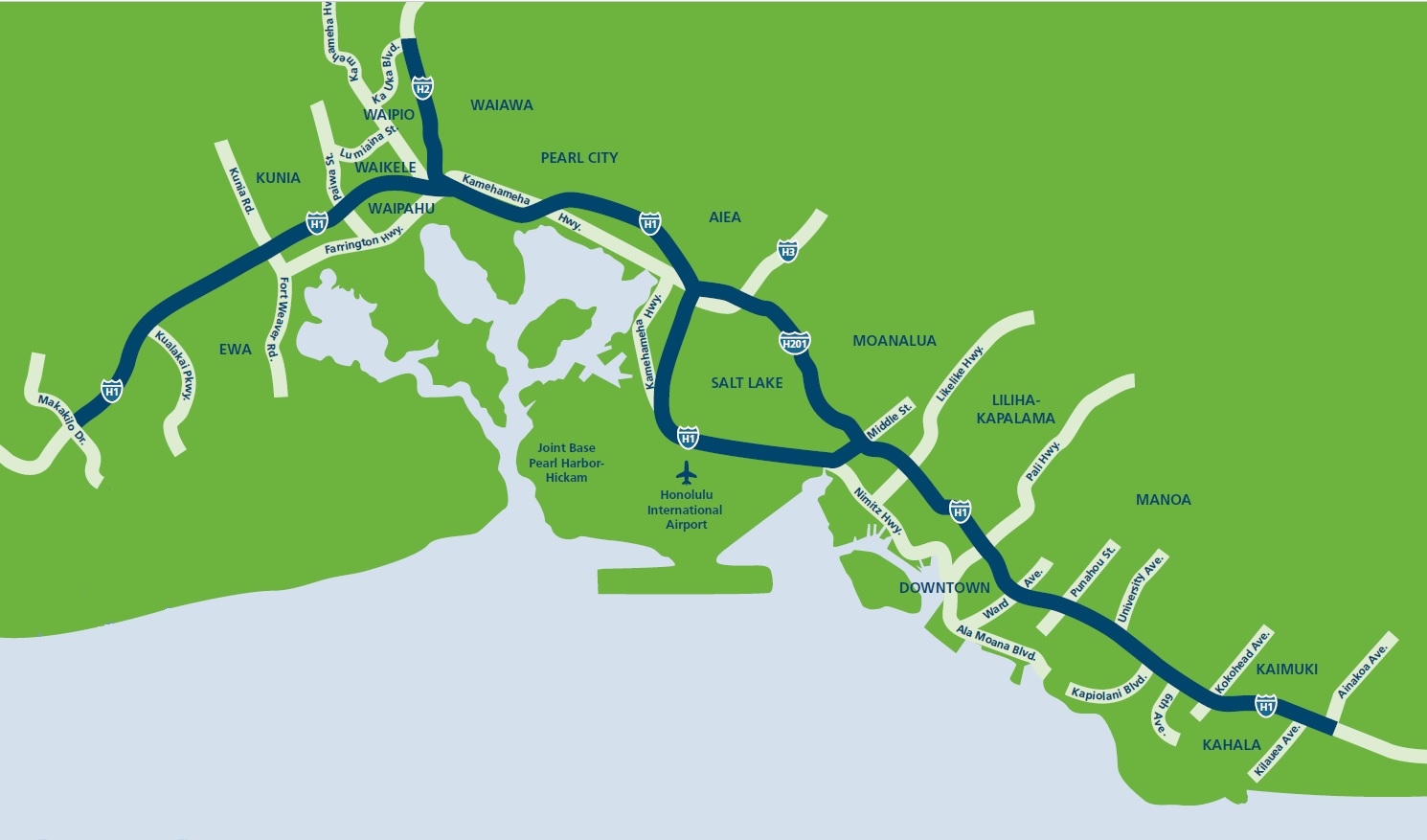 Click image to enlarge
These sections were selected because they are areas with the highest traffic volumes and the greatest potential for stalled vehicles and/or incidents which would have an adverse impact on traffic congestion.
SERVICES
To take advantage of these free services, call (808) 841-HELP (4357) to
contact the Freeway Service Patrol between the hours of 5:00 a.m. and 7:00 p.m.,
Monday through Friday, except for holidays observed by the State of Hawai`i. Watch
for the Freeway Service Patrol name and the Hawai`i Department of Transportation
seal on the tow trucks that will operate on the H-1, H-2 and H-201 (Moanalua)
freeways.
The Freeway Service Patrol program works closely with the Honolulu Police
Department. If you should need emergency assistance outside of the hours or service
area of the FSP, you can request for assistance from the Honolulu Police Department
or other appropriate agency may respond to 911 distress calls when the Freeway Service Patrol is not working (see operating hours).
The Freeway Service Patrol offers a variety of services to assist motorists with their stalled vehicles. These services include:
- Changing flat tires
- Jump starting your car
- Radiator refills
- Making minor temporary repairs
- Providing a gallon of gasoline (diesel is not available)
- Towing your car to the shoulder of the roadway or to an authorized drop area
Freeway Service Patrol operators gladly assist in attempting to get a
vehicle started and back on the road. The objective is to increase safety for
stranded motorists while allowing vehicles to continue to move. Once the vehicle is
off the freeway in a safe location, motorists can utilize their own private tow service, insurance company or
other form of assistance.
Since FSP may be the first to respond, Operators are trained in first-aid and CPR.
The services provided include:
- Changing flat tires
- Jump starting your car as a result of a dead battery
- Radiator refills
- Making temporary repairs
- Providing a gallon of gasoline (diesel is not available)
- Towing your car to the shoulder of the freeway to an authorized drop area
No, the Freeway Service Patrol is not equipped to tow heavy vehicles or specially modified vehicles. Also, if vehicles are involved in a motor vehicle collision, they may not be towed unless directed by the Honolulu Police Department.
Motorists should call (808) 841-HELP(4357) and know that Freeway Service Patrol trucks are already patrolling the freeway, so they will already be on the road and searching for stalled vehicles to help. In addition, all Freeway Service Patrol vehicles are monitored by a global positioning system (GPS) to monitor where they are located and how they can best be utilized or dispatched to motorists who need assistance.
Motorists are encouraged to call the Honolulu Police Department utilizing the 911 system if they need assistance outside the Freeway Service Patrol hours of operation or service location.
How does the GPS System Work?
The Hawai`i State Department of Transportation uses advanced technology to
monitor the location and direction of the Freeway Service Patrol trucks that patrol the freeways. Using a GPS location device called Geotab the Hawaii Department of Transportation is able to monitor each Freeway Service Patrol truck's locations and movements in real time. This technology allows for a faster response to calls for service or emergencies.
The City & County of Honolulu's Police, Fire, Emergency Medical Services and the Department of Transportation Services, have been key in developing the program's operational procedures. The Honolulu Police Department plays a critical role in the process and developed procedures so that the Freeway Service Patrol will be contacted in the event of motor vehicle.
The Honolulu Police Department responds to calls for assistance via the 911 system that are outside of the Freeway Service Patrol service area or hours of operation. When appropriate,the 911 system will also dispatch the Honolulu Fire Department or Emergency Medical Services.
EQUIPMENT/DRIVERS
The trucks were specifically built for the Freeway Service Patrol in Hawai`i and each tow truck costs about $95,000 to build and equip. The Freeway Service Patrol fleet of vehicles consists of 10 medium size tow trucks, with emergency lighting, tools and equipment to efficiently respond and remedy minor mechanical issues.
Yes, these trucks are specially designed to remove stalled vehicles from the road quickly. In addition to a traditional tow truck, the 10 tow trucks are equipped with push bumpers, low-profile wheel lifts, and have motorcycle towing capabilities, which allow the Operators to quickly and efficiently tow vehicles when necessary. If towing or pushing a vehicle is not possible, each truck is equipped with straps that can pull vehicles out of the traffic lanes in order to move motorists to a safe location and keep traffic moving.
All Freeway Service Patrol Operators must take and complete an extensive training program that consists of classroom training, in-the-field hands on instruction, and then must pass a program proficiency test. Since the Freeway Service Patrol may often be on the scene, Operators receive extensive training on the mechanics of tow and dispatch operations, vehicle inspection and maintenance, and basic car repair.
All Freeway Patrol Service Operators have been trained in basic first-aid and CPR.
They have also received specialized training in fire extinguisher and recognizing
hazardous materials. Training also includes incident management response,
safety precautions, and customer service. Last but not least, all operators must
pass substance abuse training, screening and are subject to random testing.
PROJECT COSTS AND OTHER INFORMATION
The program costs about $3 million annually with $2.7 million coming from
the Federal Government and the remaining $300,000 from the Hawai`i State Department
of Transportation. The trucks were built specifically for the Freeway Service
Patrol in Hawai`i and each tow truck costs about $95,000 to build and equip.
While this may seem like a lot, studies show that for every tax dollar spent on the
Freeway Service Patrol services, the public can realize a benefit-to-cost ratio of
many times above the amount spent to fund the program. A recent study by the Hawai`i State Department of Transportation calculated the average benefit-cost for the first two years of FSP service at just under 8:1. This means that for every dollar spent, motorists received about $8 in benefits. These benefits are measured in terms of reduction in delay, vehicle-hours, savings in fuel, and decreases in emissions. These ratios do not factor in the benefits associated with air quality improvement or collision reduction.
No. Freeway Service Patrol Operators are not allowed to accept tips or gratuities of any type.
The program coverage area has been extended three times. Today, the Freeway Service Patrol covers approximately 33 miles of freeway in both directions, including a 26 mile stretch along the H-1 Freeway from Makakilo Drive to Ainakoa Avenue, a 4.8-mile stretch along the H-201 (Moanalua) Freeway, and 2.1 miles of the H-2 Freeway from the H-1/H-2 interchange to Ka Uka Boulevard.
Motorists can help prevent their vehicles from having a breakdown on the freeway by taking some precautions and through regular maintenance.
- Check your gas gauge; fill up when it reaches a quarter tank
- Check the coolant level
- Maintain proper air pressure in your tires
- Check the tire tread on a regular basis
- Keep your vehicle in sound mechanical condition
Despite your best efforts, if you have a breakdown, try to negotiate your vehicle to the right side of the roadway, turn on your emergency flashers, and call (808) 841-HELP (4357). Freeway Service Patrol will be on the way to help you. (If out of the Freeway Service Patrol area or after hours, call 911.)
To request Freeway Service Patrol services, call (808) 841-HELP (4357). Additional information about the Hawai`i Freeway Service Patrol may be requested in writing or by calling:
Public Affairs Office
Department of Transportation
869 Punchbowl Street, Room 112
Honolulu, Hawai`i 96813
Phone: (808) 587-2160
Fax: (808) 587-2313
Email: dotpao@hawaii.gov